Kumbh · Mahakumbh
The largest gathering on the Sangam
The Kumbh Mela rotates between four river sites in India, and at Prayagraj it is held at the Triveni Sangam. This page explains the tradition and how the gathering is organised; it does not announce dates for any specific edition.
Background vs. a specific event
Everything below is general background
Details for any particular Kumbh — dates, sector plans, entry routes, parking, camp bookings and rail arrangements — are issued by the Mela administration for that edition only. Treat this page as history and orientation, and take timings and logistics from the official notice for the year you are travelling.
What is the Kumbh Mela?
The Kumbh Mela is a mass Hindu pilgrimage centred on ritual bathing in a sacred river. It is held in rotation at Prayagraj, Haridwar, Ujjain and Nashik, with the timing of each determined by the positions of the sun, moon and Jupiter in the Hindu calendar.
Religious significance
In tradition the gathering is linked to the story of the churning of the ocean, in which drops of amrit, the nectar of immortality, fell at these four places. Bathing during the Mela is believed to carry exceptional merit.
Why Prayagraj
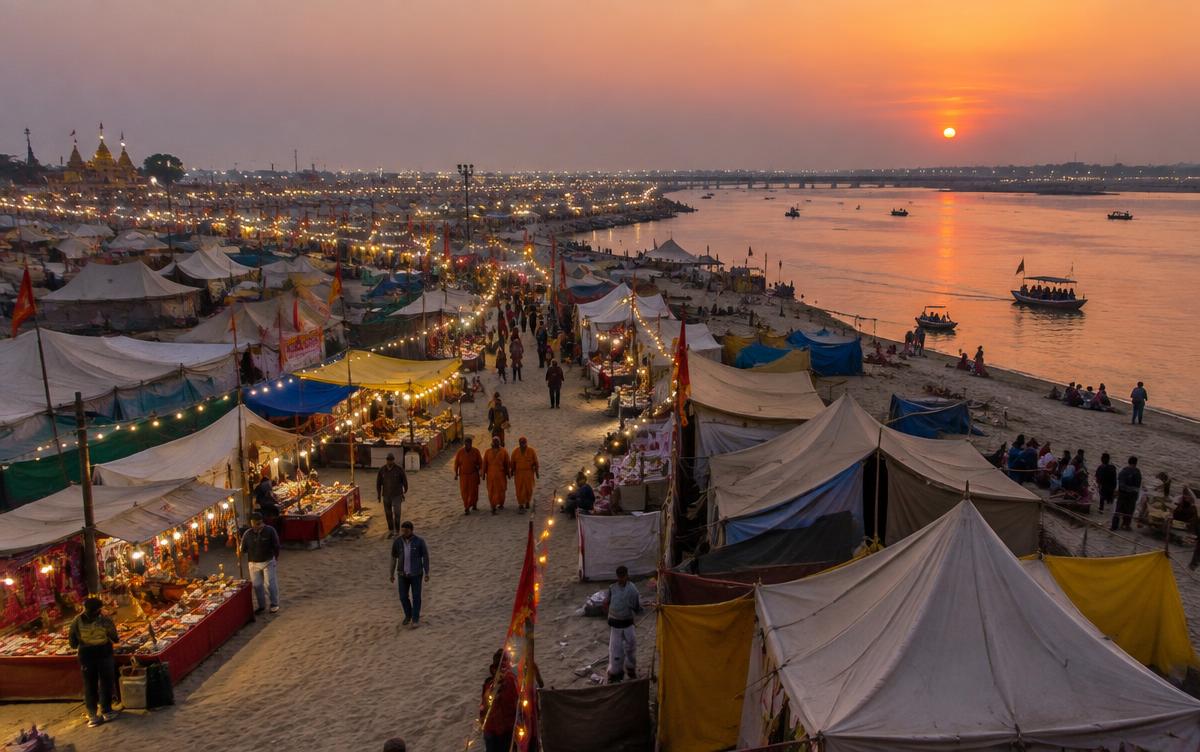
Prayagraj holds the confluence of the Ganga and the Yamuna, with the Saraswati present in tradition. Of the four Kumbh sites, the gathering at Prayagraj is historically the largest, and the wide floodplain here allows a temporary township of tents, roads, pontoon bridges and hospitals to be built each time.
Akharas & processions
The akharas — orders of ascetics, including Naga sadhus — occupy allotted sectors and proceed to the confluence in a fixed order on the principal bathing days. Their processions are central to the character of the Mela.
Pilgrimage & bathing days
The principal baths fall on days such as Paush Purnima, Makar Sankranti, Mauni Amavasya, Basant Panchami, Maghi Purnima and Mahashivratri. The exact dates and the designated shahi snan days differ for each edition.
Accommodation
Options include tented camps inside the Mela area, ashrams and dharamshalas, and hotels across the city. Allotments and bookings open for each edition, and demand around the main baths is extreme.
Transport
Special trains, additional buses, designated parking zones and managed one-way routes are put in place. On the busiest days vehicle access close to the Sangam is usually restricted and long walks are unavoidable.
Safety in very large crowds
- Memorise your sector number and the nearest landmark or gate.
- Never move against the flow of a dense crowd; step aside and wait.
- Keep a contact card on children, the elderly and anyone unwell.
- Carry water, medicines and a small torch.
- Use only pontoon bridges and routes that are open in your direction.
- Note the lost-and-found centre nearest you, and call 112 in an emergency.
Frequently asked questions
- How is Kumbh Mela different from Magh Mela?
- Magh Mela is held every year at Prayagraj in the month of Magh. The Kumbh is held at longer intervals and on a much larger scale, with the Ardh Kumbh at roughly half that interval.
- What is Mahakumbh?
- Mahakumbh is the name used for the largest of these gatherings at Prayagraj, occurring at the longest interval in the cycle and drawing the biggest crowds.
- What are shahi snans?
- Shahi snan, also called amrit snan, are the principal bathing days on which the akharas proceed to the confluence in order, followed by the general body of pilgrims.
- When is the next Kumbh at Prayagraj?
- Dates are set by the astronomical calculations of the Hindu calendar and confirmed by the state and Mela administration. We do not publish a date here until an official notice is available.